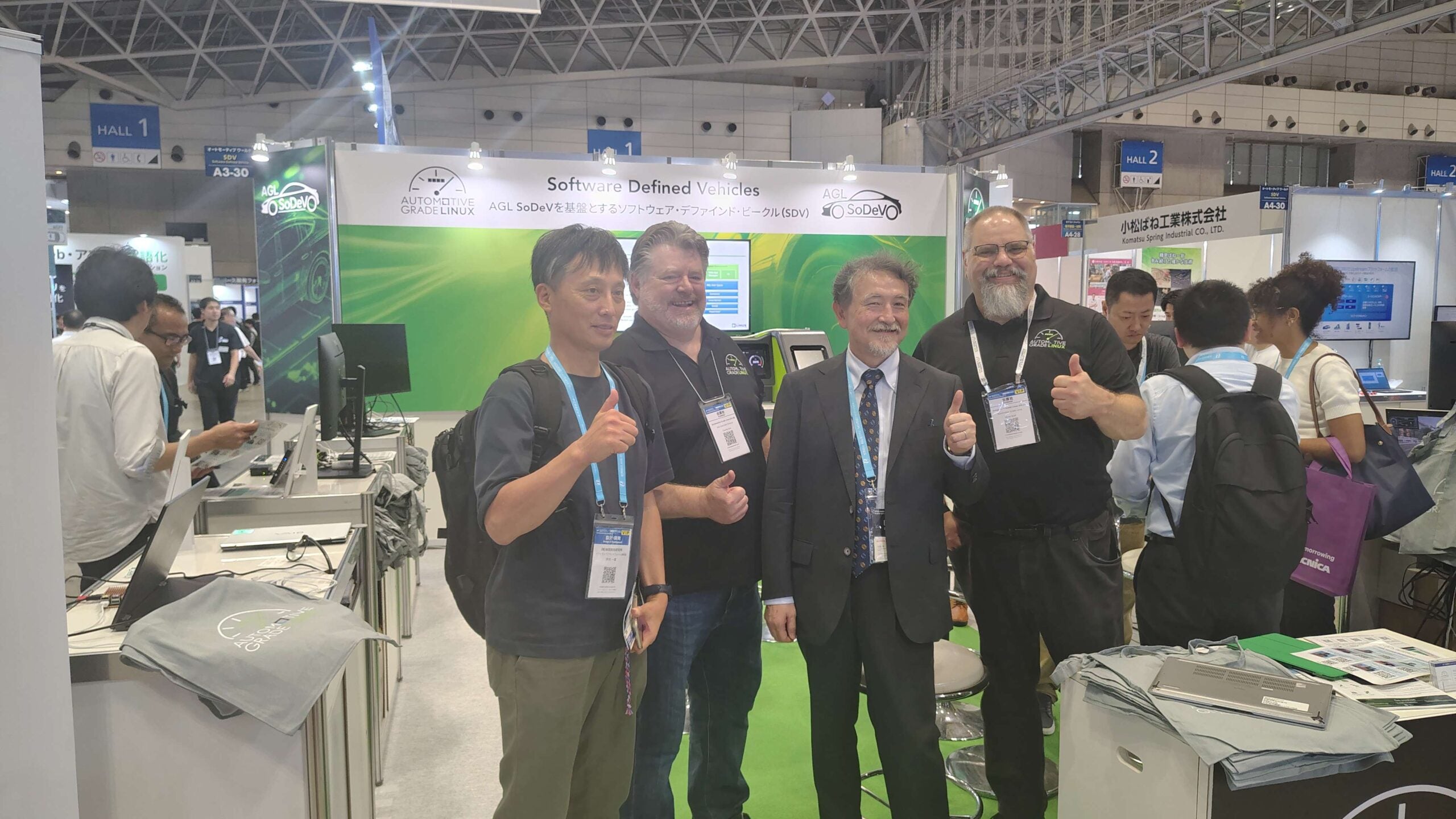
Today, we’re getting to know Kenta Murakami, Staff Engineer from Panasonic Automotive Systems and learning more about his journey in automotive software, his contributions to AGL, and his work on Unified HMI. He also shares what drew him to the AGL community, the role of AI coding tools in his work, and his hopes for the future of AGL and software-defined vehicles.

1. Tell us a bit about yourself – how did you get your start in automotive technology?
I got my start in automotive technology when I joined Panasonic Automotive Systems Co., Ltd. At university, I studied machine learning, and at that time, I didn’t know much about the automotive industry.
However, I have come to love this field because it allows me to work with people around the world through communities like AGL. I also enjoy being part of such a rapidly evolving industry, especially now that software is advancing quickly for Software Defined Vehicles (SDVs).
2. What are you working on within AGL? Can you sum up your experience so far?
I contribute to Unified HMI, a software-defined display virtualisation technology developed by Panasonic Automotive Systems.
Unified HMI can remotely render HMI applications on displays without requiring a direct connection to the SoC or virtual machine where the applications are running. It also enables seamless layout management across displays.
I joined the AGL community after about two years at my company and have been contributing Unified HMI to the AGL Unified Code Base (UCB) for around four years.
Now, I also participate in the SDV Expert Group while continuing to contribute Unified HMI to the AGL UCB.
3. What do you think is most important for AGL to focus on in the next year?
I think AGL should continue attracting more automotive companies and developers to the community. Recently, AGL has done a great job promoting its activities, and many new companies have joined, partly because the SoDeV project has been gaining a lot of attention.
I was especially happy to see some of these companies show interest in Unified HMI. I’m glad to have more colleagues who share the same goal.
At the same time, I don’t see many young members like myself at AGL events. I’d love to see more young developers join the community, and I hope we can work together to make AGL even more exciting and vibrant for the next generation.
4. What advice would you offer other developers or software engineers interested in getting started with AGL?
“Don’t be afraid to join this community, especially if you’re a young developer. If you have motivation and respect for others, community members are always willing to help you and provide great opportunities for your growth.”
I was really nervous the first time I joined this community because I had limited knowledge and experience with AGL and automotive technologies. However, once I found the courage to talk with community members, I discovered how welcoming and friendly they were. They always share a lot of knowledge with me and give me many valuable experiences.
5. What technology could you not live without?
AI coding tools.
When I first started working with AGL, I felt there was a high barrier to building AGL images from Yocto recipes. There are many dependencies between recipes, and working with AGL requires knowledge across a very wide range of technical areas. It was not easy to overcome those challenges.
AI coding tools help me by summarising information across a huge number of recipes and assisting with development in areas that are new to me. Because of that, they lower the barrier to getting started with AGL development.
More recently, I worked on enabling Unified HMI to support SoDeV. AI coding tools were extremely helpful for understanding the SoDeV architecture and assisting with debugging. Thanks to that support, I was able to complete the work in a short period of time.
6. Where do you hope to see AGL in 5 years?
I hope to see a future where more automotive manufacturers develop their software platforms based on AGL and where Unified HMI is adopted by many of them.
In recent years, several Japanese OEMs have already developed their own infotainment systems based on AGL, and I hope to see this trend continue and expand globally.
I believe the vision and goals of AGL provide great value for OEMs. Because of that, I expect more and more companies to recognise the benefits of AGL and actively use it in their products.